Male Gray Fox
Wednesday, June 29, 2005
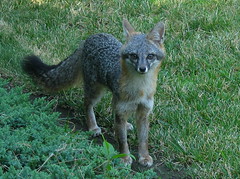
One night last week, I was in my yard at about 10:00 at night, getting ready to take a swim. Suddenly, my three cats ran away from some bushes under two tall trees, and out stepped this male fox. The cats came to stand by my side, and we all watched each other. A couple of days later, I came home from church on Sunday, about noon, and saw both foxes on the wall at the back of my yard. While I watched, the male climbed high in an oak tree. Over the next two days, I took over 50 photographs, of which I've chosen six to post here. This morning (Wednesday), I have not seen them yet, but as recently as sundown yesterday, the female was sitting on the back wall. The cats have grown used to them, and ignore the foxes, but I am having a wonderful time watching them. My yard is in suburbia, with other houses all around, and the wildest animals we usually get are birds or opposums. Behind my house is a large parking lot, with bushes around the edge. I suspect the foxes catch mice there, or other small animals and birds. They also seem to have eaten all the fruit from my neighbors' apricot tree. They may be eating figs from a fig tree that I have. But for me, a few figs is a small price to pay for such a good show. How far from the city must you go to see foxes in China?
Gray Fox in Suburbia
Tuesday, June 28, 2005
On advice from Lucien, I am now trying Flickr for posting pictures to my blog. My first observation is that they show up in reverse order from how I entered them, so read bottom to top. These are the two foxes I've been having so much fun with for the last several days.
www.flickr.com
|

A Female Nephila from Zhaotong
Tuesday, December 28, 2004
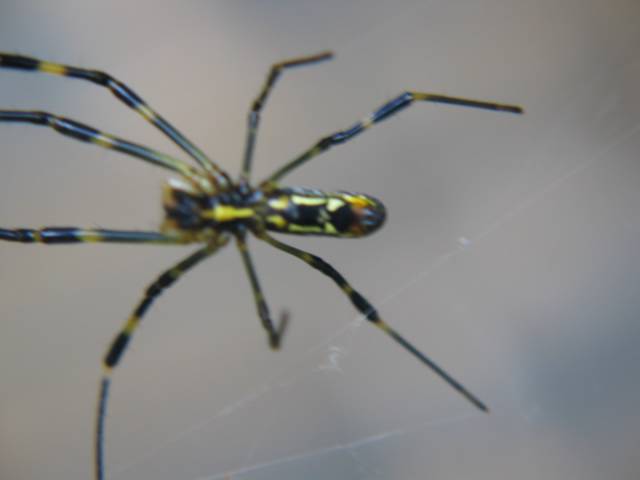
I took this picture of a female Nephila sp. near Zhaotong, north-eastern Yunnan, on August 10, only about two hours before a 5.6 earthquake hit Zhaotong. The Chinese have studied watching animal behavior to predict big earthquakes, but if this Nephila knew the earthquake was coming, she didn't tell me. The genus Nephila is common to tropical regions around the world, and I had a species where I lived (1985-1995) on the Colombian Llanos. They were the biggest web-spider that we had there. The web spun by Nephila is the strongest fiber occuring in nature. It is much stronger than a piece of steel of equal weight. The Nephila webs are sometimes built across trails in the jungle. I have been walking down a trail and suddenly walked face-first into a Nephila web. The first few times, it shook me up, but then I learned to watch for them, and they became one of my favorite spiders. I also saw many Nephila at a Buddhist temple near Dali, in far western Yunnan.
Oak galls of Central California

A couple of days ago, I promised pictures of the wasp galls that cover the leaves of the oak tree in my back yard. However, after a rain, fog and cold weather, I was unable to find much to take pictures of as I was raking leaves today. Even two or three weeks ago, there were several different kinds of galls to see. Fortunately, I have a friend who already has a complete set of photographs on the web. About seven miles (11 kilometers) from my house is the Kaweah Oaks Nature Preserve. My friend Irene Lindsey has spent several years developing an excellent web collection of photographs an text describing the plants and animals of the Kaweah Oaks Preserve. The main page can be found at http://kaweahoaks.com/
The site has many interesting pages, but pictures of the oaks galls can be found directly at
http://kaweahoaks.com/html/galls_ofthe_voaks.html
Another link on Irene’s site describes the spiders that live in our area, and at Kaweah Oaks Nature Preserve. I gave Irene a little help with that section, and another friend of mine, Dr. Marjorie Moody, gave her a lot of help. The spider section begins at http://kaweahoaks.com/html/spiders.html Go to the "Spider Checklist" for the part I worked on.