Leonard Cohen, and thoughts related to the Yom Kippur war of 1973
Wednesday, October 11, 2023
(In mid September, 2022, I began a series commemorating the 50th anniversary of my coming-of-age trek across Europe and Israel in 1972. I posted eleven episodes before being interrupted at Thanksgiving time. This would probably come in at something like episode twenty, but I'm putting it here for other reasons which should become obvious. Technical difficulties prevented me from posting this when I first wrote it, on September 24, which was the 50th Yom Kippur since the 1973 war. It was also before the outbreak of the war now being fought.)

At a couple of minutes before 2:00, on the afternoon of Yom Kippur (October 6, in 1973, but ending at sundown this evening, September 25, 50 years later), when a coalition with troops from twelve nations launched a surprise attack upon Israel, many Jews both in Israel and elsewhere around the world were at synagogue services, observing their Day of Atonement, the most holy fast of the year. Canadian singer-songwriter Leonard Cohen, in line by birth to the Levitical priesthood, was on the Greek island of Hydra, just off the Peloponnesian coast, with a woman named Suzanne (but not the Suzanne from his song of that name) and their toddler. He was 39 and feared he was washed up as a performer. He had never served in the military, even for his native Canada, and had the reputation of being something of a pacifist. Although he had lapsed as an observant Jew, at hearing the news of war, he took the ferry to the mainland, traveling light. He did not even take his guitar.
I, a gentile, was settling into my first year of marriage. We had spent our first six weeks at a family cabin at Mt. Baldy Village, just outside Los Angeles, and now we were back in the city. I had seen Cohen in concert at UCLA, three years earlier, from a second-row seat in the very center, smack dab in front of him. While attendees were arriving to fill Royce Hall, a voice in the back began to rant wildly and Cohen came from behind the curtain. The heckler came forward and the two sat on the edge of the stage and talked quietly. Cohen settled him down and gave him a parting hug. I did not know it, but just a couple of months earlier, while touring Europe, Cohen had talked his backup musicians into a concert at a mental hospital. When a patient stood mid-concert and challenged Cohen with a question about what the singer would do for him, Cohen set aside his guitar, went into the audience, and held the man in an embrace.

Only as I researched this essay did I learn that the interrupter in Royce had been actor Dennis Hopper, a friend of Cohen’s. For a period of eight days, right then, Hopper had been married to Michelle Phillips, recently divorced from both John Phillips and the Mammas and the Papas. She would be singing backup in the second half of the show, and Hopper had talked Cohen into giving her the job. For the first half of the concert, Cohen shared the stage only with a chair, a microphone, and his guitar. He sang songs that I knew well from his two albums, most notably, “Suzanne,’ “Sisters of Mercy,” “So Long, Marianne,” and “Hey, That’s No Way to Say Goodbye.” Cohen’s genius was for quiet lullabies of detachment and desperation. Cohen had difficulty forming attachments, but he had a talent for turning goodbyes into great poetry and hypnotic music.
I'm not looking for another as I wander in my time
Walk me to the corner, our steps will always rhyme
You know my love goes with you as your love stays with me
It's just the way it changes, like the shoreline and the sea
But let's not talk of love or chains and things we can't untie
Your eyes are soft with sorrow
Hey, that's no way to say goodbye

His goodbye to Suzanne (not that Suzanne) on Hydra was more of a ‘I’m not sure what I’m doing, but I know I have to go, and I may be back.’ He got on the ferry, and then an airplane, and arrived at Lod Airport in Tel Aviv.
Eleven months previous, I too landed at Lod, with even less reason to be there. After graduating from UCLA, I bought a one-way ticket to London, thinking I would get as far as France to spend a year. Then, before I could actually use that ticket, I fell hard for the only woman I have ever loved, and to whom I am married today. Cohen and I are opposites in so many ways, yet his songs have fascinated me now for some 55 years.
I knew I was coming back Stateside in just a few months. However, while hitch-hiking through Europe, doors opened and doors closed, rides either materialized or didn’t, and instead of Paris, I visited Amsterdam, Berlin, Basel, Venice, Belgrade, and Istanbul. First in East Germany and then in the West, I encountered God in a way I could never go back upon, and in ways I don’t believe Cohen ever did. When doors opened to direct me to Israel, I was ready for it. I arrived at Lod airport on an El Al flight from Istanbul. At both ends of the flight, passengers faced the strictest security I have ever seen, even after 9/11. In that November, 1972, only six months had passed since members of the Japanese Red Army pulled machine guns from their luggage, killing 26 and injuring 80.
Cohen had been to Jerusalem in April, at the end of his 1972 European tour. Once on stage, he’d become flustered when the crowd applauded after the first few words of “Like a Bird on a Wire.”
Like a bird on the wire,
like a drunk in a midnight choir
I have tried in my way to be free.
He stopped singing and explained why he could not go on with the concert, “…it says in the Kabbalah that unless Adam and Eve face each other, God does not sit on his throne. And somehow, the male and female part of me refuse to encounter one another tonight, and God does not sit on his throne. And this is a terrible thing to happen in Jerusalem.” (https://www.israellycool.com/.../when-leonard-cohen.../) Cohen then walked off, followed by the band. At that point, the audience took up spontaneous versions of well-known songs in Hebrew. Back stage, Cohen shaved while the promoters and band tried to coax him back on stage. In his guitar case, he found an old package of LSD, which he split up among them, later describing the shared acid as “like the Eucharist.” It was Cohen’s special talent to use sacred imagery to describe the profane. After this ‘priestly’ duty, Cohen returned to the stage, crying, to listen to the crowd sing, and add a song of his own.
In Jerusalem, I located an acquaintance from UCLA, named Ilene. The next day, she snuck me onto a field trip with her Palestinian Archeology class. In the role of academics, we hopscotched north along the Jordan River, to stops in Galilee and catacombs near Haifa, listening to lectures. Then Ilene and I hitchhiked for a weekend in Safed, an artist’s colony and the highest city in Israel. Under the Ottoman rulers, Safed had been the study-center of Kabbalah. Alongside Israeli soldiers, we waited for rides at hitching points. The soldiers then put in a good word for us with any drivers who stopped. We rode along the border of the Golan Heights, chatting with our armed escorts. In Safed, we watched a continuous pattern of Israeli Air Force planes patrolling the Lebanese border, only about ten miles away.
In Tel Aviv, Cohen thought he would volunteer for work on a kibbutz, but visited cafés that he remembered from the disastrous tour of 20 months earlier. There, musicians recognized him and invited him to help entertain troops in the Sinai Desert, where the war was going very badly. They found him a guitar.
Actually, the war was going badly everywhere. The simultaneous attacks from Egypt into the Sinai and from Syria into the Golan Heights had caught an overconfident and relaxed Israel during a holiday. Observant Jews were between the first and second of the three main portions of the liturgy, and non-observant Jews were indulging themselves in secular pleasures.
Cohen would have been in this second group. Although raised in a Montreal synagogue founded by his rabbi grandfather, and deeply infused by its rhythms and language, Leonard Cohen was faith-curious, but living the life of a secular man. Israeli journalist Matti Friedman, author of WHO BY FIRE: LEONARD COHEN IN THE SINAI, describes Cohen’s public image as “a poet of cigarettes and sex and quiet human desperation, who’d dismissed the Jewish community that raised him as a vessel of empty ritual, who despised violence and thought little of states…” (p. 5). Yet much later, when Cohen was residing at a Zen Buddhist monastery, just two miles upstream from my family’s cabin at Mt. Baldy, he would tell an interviewer, “…I was never looking for a new religion. I have a very good religion, which is called Judaism. I have no interest in acquiring another religion.” (p. 41)
It intrigues me that Cohen, and an impressive list of other secular Jews, including Bob Dylan, Paul Simon, Randy Newman, and Carly Simon, provided my generation with its musical score and lyrics, the Psalms of our secular experience.
Cohen knew well that he had been born in the bloodline of priests—Kohanim in Hebrew—running through his grandfather, then through 3,000 years of fathers and sons to the generation of Zadok, chief priest at the time of Solomon’s Temple. Finally it sound its Levitical source in Aaron, the brother of Moses. Cohen struggled with that. A new acquaintance in Tel Aviv sized him up quickly, “You must decide whether you are a lecher or a priest.” (p. 166). In notes he assembled just after the war, perhaps for a novel he never produced, Cohen recounts, “The interior voice said, you will only sing again if you give up lechery. Choose.” (p. 48). In the Temple, one whole branch of the priests were singers. Cohen was at a point in life where he doubted even that hereditary gift.
What Cohen could not have known, at least until he was living at the Zen Monastery, was that DNA studies in the late 1990s concluded that the genetic code bore out the historicity of this Kohanim tradition. Researchers have identified a pattern of genetic markers that is as much as ten times more common among Cohens than for non-Kohanim-Jews. That holds true among both Ashkenazi and Sephardic populations, and even for Lemba tribesmen in Zimbabwe and South Africa, who maintain a tradition of Jewishness.
Out in the Sinai Desert, at one end of the father-to-son chain of Kohanim, Moses recorded God’s declaration that only men from this one family could service the Tabernacle. Among their duties would be calling the people away from their daily tasks, often ministering during the worship with singing and musical instruments. Now, at the other end of the chain, Leonard Cohen, much though he might want to escape the priesthood, was heading into the Sinai to minister in music to the troops.
The Sinai was bathed in blood. The small troop of musicians would drive until they saw a cluster of soldiers, stop, and sing a few songs. Sometimes these soldiers were just arriving from hot battle, with minutes-old images of flying ordinance and falling comrades. Many were not sure who this singer was, nor could they understand the English of the songs he sang. He spoke no Hebrew. Few understood that here was a musician who had sung in 1970 before for a crowd of 600,000 on the Isle of Wight. Most were more excited to see the Israeli singers that they recognized. Cohen sang standing in a tight circle of soldiers, or sitting in the sand, or on the scoop of a bulldozer. One photograph shows him standing in front of General Ariel Sharon, who is talking to a well-known Israeli singer. Later, Sharon did not remember that Cohen had been there. (p. 141)

counter-offensive across the Suez into Egypt. At one point, Cohen helped carry stretchers with wounded soldiers from helicopters to a makeshift hospital. His memoire records that as they moved through territory that had seen recent battle, he recoiled against the sight of bodies littering the sand, but felt relief when he learned the dead were Egyptians, not Jews. Then he felt guilt for feeling that relief. Those had been some mothers’ sons. There was no LSD to cushion what he was seeing, only soldiers’ rations and quick naps on the sand. In between performances he worked out a new song, though the recorded version is gentler in places than the verses he sang in the desert.
I asked my father
I said, father change my name
The one I'm using now it's covered up
With fear and filth and cowardice and shame…
He said, I locked you in this body
I meant it as a kind of trial
You can use it for a weapon
Or to make some woman smile...
Yes and lover, lover, lover, lover, lover,
lover, lover come back to me
Yes and lover, lover, lover, lover, lover,
lover, lover come back to me
Then let me start again, I cried
I want a face that's fair this time
I want a spirit that is calm…
Yes and lover, lover, lover, lover, lover,
lover, lover come back to me
Yes and lover, lover, lover, lover, lover,
lover, lover come back to me
Of the three liturgical high points of the Yom Kippur commemoration—due to its solemnity, not to be confused with a celebration—the first, a thousand-year-old prayer called Unetaneh Tokef, had been recited before the coordinated attacks. It begins, “Let us relate the power of this day’s holiness.” It speaks of God’s judgements, the insignificance of man, and projects the idea that this Day of Atonement seals everyone’s fate for the coming year:
How many will pass on and how many be created,
Who will live and who will die,
Who will reach the end of their days and who will not,
Who by wind and who by fire,
Who by the sword and who by wild beast,
Who by famine and who by thirst… (p. 16)
This prayer formed the inspiration for Cohen’s 1974 song, ‘Who by Fire.’

During the second high point, all the male Cohens in the congregation stand around the gathering to recite a blessing that was left as a vestige after the destruction of the Second Temple, by the Romans, in 70 AD. “May God bless you and guard you. May God shine His face upon you and be gracious to you. May God lift up His face to you and grant you peace.” (p. 17)
The third and final highpoint, reached at the very end of the 24-hour fast, when everyone is tired, is a reading of the Book of Jonah, the most complex history ever presented in 48 sentences. At the beginning of 2022, on my short list of New Year’s resolutions, I wrote that I wanted to better understand Jonah. Eighteen months later, I think I am finally getting it, although perhaps I’m not taking the same message that all Yom Kippur worshippers are receiving.
Jonah, a prophet of God, is told to take a message to the people of Nineveh, not only pagans, but as wicked and blood-thirsty a city as ever existed. Jonah hops a boat going the opposite direction. He knows that he cannot escape from God, but perhaps he can escape from his job description. In a storm, he finds himself in the hands of pagans more righteous than he, but God uses him to demonstrate to those pagans His own awesome power. Then Jonah is swallowed by a fish, and surrenders himself to God’s will. The fish spits him up on the shore, and Jonah goes to preach in Nineveh. I have seen speculation that after three days stewing in a fish’s stomach juices, Jonah may have arrived in Nineveh looking like God’s demonstration project. The Ninevites repent, and God spares them from the judgement that He had pronounced. Jonah goes to sulk on a hilltop, where God provides a vine for shade and then a worm to kill the vine. Jonah is angry at God, both for His mercy on the wicked Ninevites and for taking away the protective shade, and God challenges him that he has no right or reason to stand in judgement on the Creator.
Why should Jonah’s memoire be read as the culminating activity on the Day of Atonement? In a very real sense, Jonah is Everyman, and we are all in need of atonement. We have all, together, and each, individually attempted to run from God and the job descriptions He has given us. We have all and each of us attempted to cast judgement on God for both the unrighteous who He has blessed and the righteous He has apparently overlooked. Even honest atheists, if they examine their hearts, will likely discover that their disbelief in God is rooted in those judgements.
But for Israel—and ratchet it up a notch for the Cohens—the job description is even more direct. Beginning with Abraham, God’s chosen people, like Jonah, were chosen to be God’s demonstration project. In this allegory, the rest of us are Ninevites.
The temptation for the chosen is to run as Jonah did, or to pass the job description off on others. Fiddler on the Roof’s Tevye, addressing God, says, “I know, I know. We are Your chosen people. But, once in a while, can't You choose someone else?”
God very clearly sets out the stakes in this demonstration. By the time we get to Deuteronomy, chapters 27-30, Moses has completed his 40 years leading the Hebrews around in the Sinai. He gives his final instructions—rules against theft, mistreatment of the vulnerable, and lechery. Then, before turning them over to Joshua’s leadership and sending them across the Jordan, Moses tells the leaders that once they are in Israel, they are to put half the people on Mount Gerizim. There, they will shout a list of blessings that will come from obedience to God. Facing them, the other half will stand on nearby Mount Ebal, to shout curses that will follow disobedience. The script acknowledges that it’s for demonstration purposes. Concerning the blessings: “Then all the peoples on earth will see that you are called by the name of the LORD… “ (28:10a) Then later, concerning the curses: “The LORD will cause you to be defeated before your enemies. You will come at them from one direction but flee from them in seven, and you will become a thing of horror to all the kingdoms on earth.” (28:25). And again: “You will become a thing of horror, a byword and an object of ridicule among all the peoples where the LORD will drive you.” (28:37)
The curses require a long chapter, remarkably foretelling the actual experience of the Jewish Diaspora: “Then the LORD will scatter you among all nations, from one end of the earth to the other…” (28:64) “Among those nations you will find no repose, no resting place for the sole of your foot. There the LORD will give you an anxious mind, eyes weary with longing, and a despairing heart. You will live in constant suspense, filled with dread both night and day, never sure of your life.” (28:65-66)
However, Chapter 30 speaks of a restoration. Many of the families that were taken away to Babylon in the exile never got back to Israel. Cohen’s ancestors became Polish and Lithuanian Ashkenazim. Other families became the Sephardic population of Iberia. Yet over the course of 2,500 years they never lost their identity or the pull of the land. “Then the LORD your God will restore your fortunes and have compassion on you and gather you again from all the nations where he scattered you. Even if you have been banished to the most distant land under the heavens, from there the LORD your God will gather you and bring you back.” (30:3-4)
That pull was so strong, that when a secular and lecherous Canadian Cohen, while fleeing his priestly calling, heard that Israel was under attack, his response was, “I’m not sure what I’m doing, but I know I have to go, and I may be back.”
Thanksgiving 2022
Thursday, November 24, 2022
(We interrupt the previously scheduled episode recapping my 1972 Coming-of-Age Jaunt through Europe, to interject this Thanksgiving message.)
I am thankful, three weeks before my 73rd birthday, that most of my deadlines these days are self-imposed and freely adjusted. Had I been able to maintain my original plan, this week would have had readers with me in Jerusalem, where I celebrated my 1972 Thanksgiving meal with a jar of peanut butter and the loaf of bread I hoped to stretch for a few more days. Instead, the recap falls short by six weeks and eleven nations. I was still in England, and still thinking I would spend most of my sojourn in France. I anticipated upgrading my high school French and working on my novel. I certainly had no inkling of getting as far as Israel. I had, however, just committed to visiting a new friend in Switzerland.
I give thanks for my God-bestowed but only-recently-acknowledged ADHD. Even as—at this stage in life—unfinished projects challenge me in space and time, the fascinating twists and turns of my distractibility refuse to let me become bored. I am rich in both hobbies and relationships. All by itself, my whimsey in spiders has brought me friendly correspondents on six of the seven continents. My early teaching career allowed me to teach groups of junior high students, and in some cases, my later career brought me their children and grandchildren. Members of each group now show-up richly on my FB friends list. As God supplied me with diverse teaching venues, I once had a class of Cacua-speaking adults from the remote jungles of Colombia. They needed the basics of government and economics to help them pass their (Spanish-language) primary-school equivalency exams. We taught the class tri-lingually. Later, in China, I had three weeks with high school and college students who hoped to improve their English. Over the years, God gave me experiences with both public and Christian school students in California. In the middle, for a decade, I taught a tightly-knit cadre of students in Colombia. Some of those children I had the privilege of shepherding from fifth grade through twelfth, and I’m able to correspond with them now as adults. For all this I am thankful.
I am thankful for the families God has given me, both the family of my birth, and the family I began 50 years ago (next July) by marrying Vicki. In July, I camped with the cousins among whom I grew up. We who could remember our wonderful grandparents and great-grandmother could now see each other’s grandchildren. This week, Vicki and I have three of our five children, with their spouses, and seven of our fourteen grandchildren. My step-counter tells me that in the five days since the grandkids arrived, my daily walking stats double over the average from the previous six weeks. Few gratifications in life can match watching grandchildren grow and their parents negotiating the challenges. The oldest two boys have their voices changing. The younger ones still want to cuddle with Papa and have stories read. I also thank God for the amazing technology that allows me to teleport to Brazil to help homeschool my grandsons there, and then zoom over to England to keep current on the antics of my British grands.
My life puts flesh to the end-time description given by God to Daniel, “Many shall run to and fro, and knowledge shall increase.” (Dan. 12:4, ESV). Living now, two-and-a-half millennia after God instructed Daniel to “shut up the words and seal the book, until the time of the end,” I am grateful to have a storehouse of ‘to-and-fro’ memories from visits to twenty-some countries. I also carry more information through my pocket phone than Ben Franklin or Thomas Jefferson could access had they owned every book then in print. I am thankful for capabilities unavailable to any previous generation. I am also grateful for the Scriptures that provide a solid place to stand as floodwaters shift the sand from all around us.
As a child born just at the end of two World Wars, I have lived through a Cold War and times of increasingly dangerous proxy wars. I am thankful that both I and my children have been spared the call to arms. Amidst ‘wars and rumors of war,’ I am thankful that, in my call to overseas service, I could carry literacy rather than kill-or-be-killed armaments. I could spread the Word of Life rather than the Kiss of Death. I am thankful to be living in a pocket of peace, the likes of which so many in our world are unable to enjoy. I am not facing a winter without heating, nor the threat of incoming missiles. I have done nothing to deserve these blessings that I enjoy, just as many of the people without them have done nothing to deserve their absence. Even in Colombia, which was struggling with a civil war within our earshot, I could say, as did David, “In peace I will lie down and sleep, for you alone, LORD, make me dwell in safety.” (Psalm 4:8). For this I am thankful.
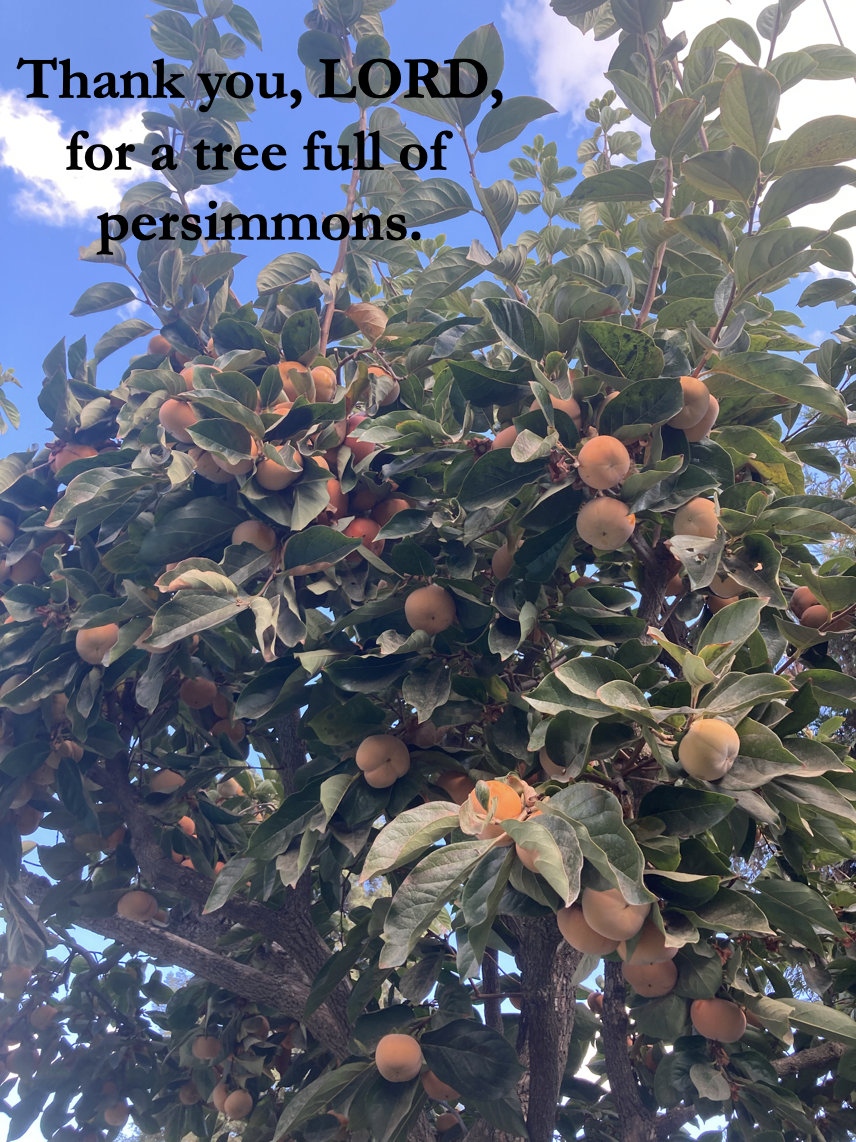
(A conversation, just now, with my Brazilian son-in-law reminds me how thankful I am to be familiar with the tastes of both the peaches, apricots, and plums that won’t grow in the tropics, and the tree-ripened mangoes, papayas, and bananas that only show up in North American grocery stores with a pittance of their sweetness and flavor. I have tasted avocadoes, sweet and creamy as only the tropics can produce them, but have temperate-zone persimmons in the back yard as I write this.)
I am thankful that though riches and fame were never high on my list of ambitions, God’s plan for my life has delivered for me a modest level of each. I enjoy a nice house, a satisfactory pension, and a yard big enough to entertain my horticultural curiosities. Although—as late as 2016—I entertained no ambition to run for elective office, in 2018, I finished ahead of the Libertarian in my race for Congress, and in 2020, an amazing 42,015 voters marked their presidential ballots for me. I am thankful for each one of you. That total exceeds even the popular votes for George Washington (39,624 in 1788-89, and 28,300 in 1792) and for John Adams (35,726 in 1796). I am thankful that both Washington and Adams performed so well in the strenuous times with which they were faced—as have generations of patriots since—and that my family and I can enjoy the benefits thereof. I pray that those benefits will continue.
Even as God blessed me in ways I never sought, He has also gratified the desires I did entertain. I wanted to leave the world a better place for my having been here. Now, I can look at five grown children who are each contributing to the betterment of mankind. I can look at three generations of students whose lives I have touched. I can see riders lined up to utilize a bus system for which God put me in the right place at the right time to help get started. I can look back at teenagers I encouraged in the 1980s—coming from the pre-literate, indigenous peoples of Colombia—students who went on to graduate from prestigious universities, and who now supervise educational systems they have built from the ground up, on land to which their people now hold legal title. I hear of hundreds now worshipping Jesus among people-groups that had none fourty or fifty years ago. Oh, the marvels I have witnessed! Thank you, LORD!
On this Thanksgiving Day, 2022, I pray that each of my readers will enjoy a time of family and good food. I pray for God’s peace among those, worldwide, who currently feel the weight of man’s free will, expressed as it so often is, as man’s inhumanity to man. Come quickly, Lord Jesus.
Coming of Age, 1972: Episode #10
Saturday, November 05, 2022
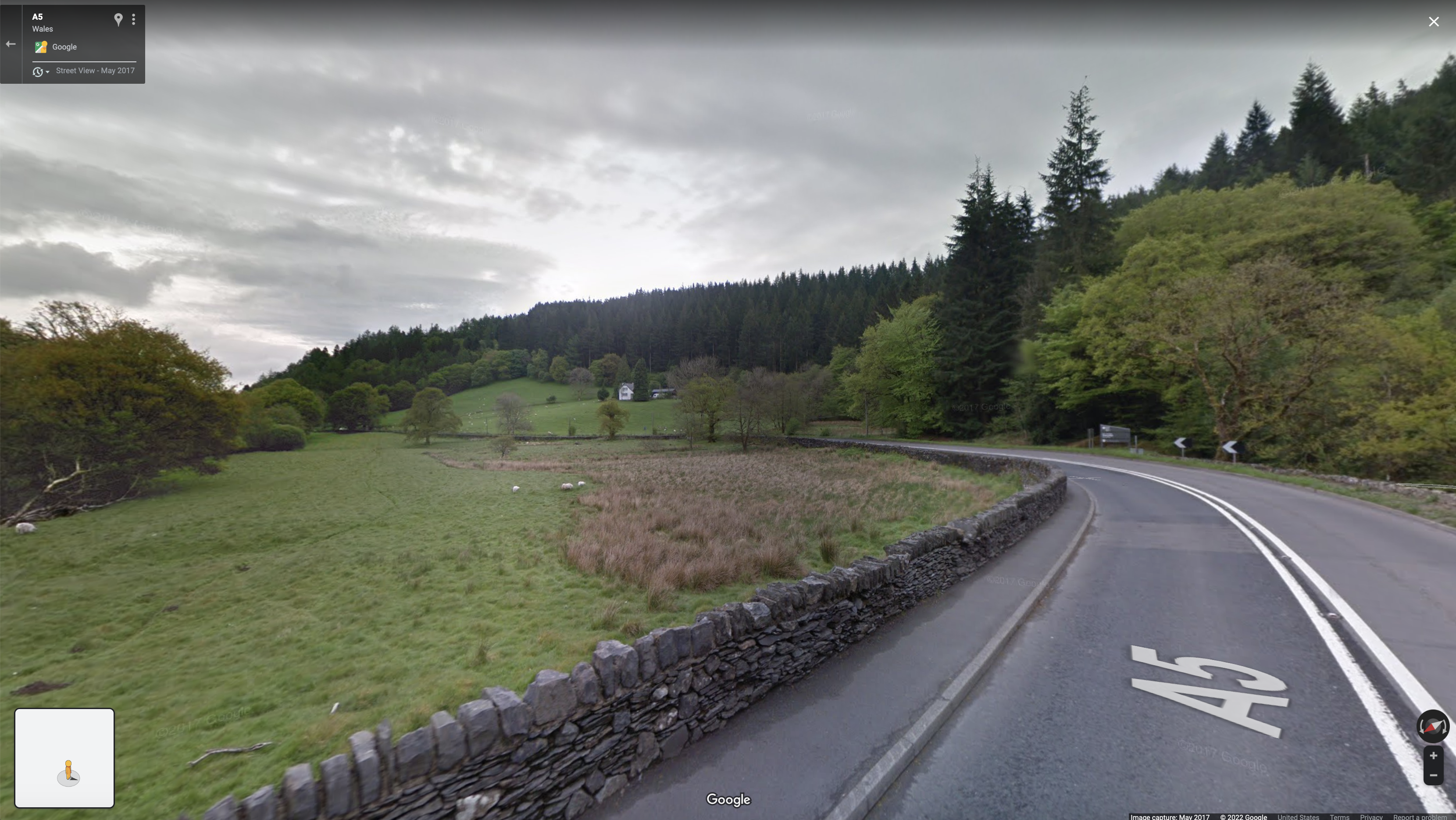
The night ferry from Dublin brought me to Holyhead, at dawn. From there I set my feet for London, hoping to find waiting mail. The Welsh countryside was beautiful, and the street signs entertained me with names like Llanfairpwllgwyngyll, Glyndyfrdwy, and Brynsaithmarchog. Holyhead sits on an island, connected to the British ‘mainland’ by the world’s oldest major suspension bridge.

It was a pleasant day. By walking some and getting a few rides, I covered about 150 miles before sundown.

I only skirted the outlying districts of Birmingham, rendered magical by yellow street lamps in a slight fog. I don’t remember where I thought I might get to spend the night, but a lorry driver stopped and offered me a ride. I’ve had readers in the British Isles for eleven days now, so we might as well use the correct vocabulary. There are no truck drivers in England, only lorry drivers.
We drove the M-40 the rest of the night, and the conversation was good. Not long before dawn, he dropped me on the outskirts of Winchester, and I rolled out my sleeping bag in a recently mowed cornfield. I might have slept a couple of hours, and the sun was up when I awoke.How often does one get to Winchester? I thought I ought to get a look at the famous cathedral before I returned to my pursuit of any letters waiting for me in London. As an inveterate whistler, as I walked I whistled The New Vaudeville Band’s 1966 whistling hit “Winchester Cathedral.”
I walked naively into Winchester and took a nice look at the first big church I came to. Yeah, it was nice, if maybe not worthy of all the hype I had heard. Then, thinking I could check-off Winchester from my bucket list, I started across the city to reach the highway north. In the process, I stumbled upon the C*A*T*H*D*R*A*L. Boy-oh-boy. The laugh was on me.

I spent a goodly amount of time properly appreciating an amazing feat of architecture, built between 1079 and 1532. The interior length runs a football field and a half, with burials from an even earlier building, as far back as Cynegils, King of Wessex (AD 611–643). More recently, the Cathedral contains the remains of Jane Austin

When finally I had seen enough of the Cathedral—and seeing on the map that I was only a couple of miles from Tichborne—I hiked out of Winchester on the M-31.

In England, I could not have repeated the details, but I recognized the name had been important on my family tree. Refreshing my memory as I write this, John Tichborne (1460 - 1498), born at Tichborne, had one son, Nicholas (b. abt. 1480 and recorded as “Burgess of Hindon,” living at Tisbury, about 50 miles west of Tichborne) who sired Dorothy (abt. 1510 - abt. 1572), who married John Sambourne. Their grandson Richard (1580 - abt. 1632) married Ann Bachiler. After Richard’s death, their three sons crossed the Atlantic with their maternal grandfather, the Rev. Stephen Bachiler, and settled in Massachusetts, thereby planting my mother’s family in America.
Several days ago, when I began writing this episode, I had no idea I would be posting this on Guy Fawkes Day, nor any intension of mentioning the religious struggles of the 16th and 17th Centuries. Yet as I poked around on the web, it couldn’t help but come up.
Richard Samborne would have been distantly related to Chidiock Tichborne (1562 –1586), who was executed at age 23 for his part in the Babington Plot, a conspiracy by a small group of Catholics who hoped to murder Queen Elizabeth I, and replace her with Mary, Queen of Scots. Chidiock left behind a wife, a daughter, and three poems that can still be found in print. Other than Chidiock, the Tichborne family were able to remain Catholic and even (by concession of King James I) retain as Catholic their family chapel inside the Church of England St. Andrew’s Church in Tichborne. On the other hand, the same King James I took lands and livelihood away from Rev. Stephen Bachiler, a “notorious inconformist.” There are hints that his Bachiler line arrived in England as Huguenot refugees from the slaughters in France. It makes sense that Stephen Bachiler (1561-1656) was an early proponent of the separation of church and state in American Colonies.

In Tichborne, I found the village library and went in, but had no idea what I might find, or how to go about it. Year’s later, I discovered Tichborne’s Elegy.
Tichborne’s ElegyMy prime of youth is but a frost of cares, My feast of joy is but a dish of pain, My crop of corn is but a field of tares, And all my good is but vain hope of gain; The day is past, and yet I saw no sun, And now I live, and now my life is done.
My tale was heard and yet it was not told, My fruit is fallen, and yet my leaves are green, My youth is spent and yet I am not old, I saw the world and yet I was not seen; My thread is cut and yet it is not spun, And now I live, and now my life is done.
I sought my death and found it in my womb, I looked for life and saw it was a shade, I trod the earth and knew it was my tomb, And now I die, and now I was but made; My glass is full, and now my glass is run, And now I live, and now my life is done.
After sitting in the library for a short time, I caught a ride into London. My strongest memory is passing Wimbledon. I don’t follow tennis, but I recognized the name.

Coming of Age, 1972: Episode #9
Saturday, October 29, 2022
Once I left Limerick and turned myself in the direction of London, I felt the tug of possible mail waiting for me in Earl’s Court. All of Ireland is only one fifth the size of California, and the trip from Limerick to Dublin is about the same as a trip from Los Angeles to San Diego, though the highway in 1972 was just one lane each direction.
From the portion that I walked, my strongest memory is the carefully designed and manicured garden on front of one house. I stood for a short time to admire it, and I’m sure my neighbors ever since have wished I had learned more from the study.

The ride I remember was with an older gentleman in a truck. We rode together long enough to pass several cemeteries, and each time, he crossed himself without interrupting our conversation. This gesture had not been part of my Methodist upbringing, and I wondered now—without saying anything—whether this was an Irish show of respect for the dead, or a more general Catholic practice.

My Irish ancestors had been Catholics, although only nominally-so within living memory. In Seattle, on the very day that the lockdown lifted at the end of the Spanish Flu, my grandmother’s sister and her beau beckoned a justice of the peace to the house for a wedding, while my grandparents waited a few days to have a wedding mass. Neither marriage lasted, though, and while I was growing up, I never knew my grandmother to practice anything I could identify as Catholic. My dad, upon enlisting in the navy, faced paperwork that asked whether he was Catholic, Protestant, or Jewish. The question stumped him. He checked the middle box, while not identifying with any of them. He attended Protestant services at sea.

Vicki’s family had also been nominally Catholic, until in her early teens she asked her father to begin taking her to mass. Then, just a few months before she met me, she became fascinated by the faith she saw in a couple of Evangelical friends at UCLA. They helped her to a ‘born again’ step of faith. When we first met, she was on fire for Jesus, and many of our early conversations were Christo-centric. Indeed, at Easter, after we had known each other about six months, I took her to the beach for a day—her favorite spot—and we sat under the jets taking off from LAX. I came away from that day with a dim view of the relationship potential between an agnostic like me, and a ‘religious fanatic,’ as I then perceived her. My parting words, as I took her home, were “Vicki, I think you will make someone a wonderful wife, but it won’t be me.” To my surprise, I had said just the right thing. At the time, she was trying to slow down two other fellows who wanted to marry her, and she wouldn’t have to worry about me. Over the next fifteen months, we each had other romantic interests, and Vicki and I could just be good friends, under no pressure.
I arrived in Dublin, but didn’t see much of the city. I bought my ferry ticket for a sleeper to Holyhead and stayed close to the terminal. I do have a favorite picture of Dublin, though. It is of my mother, from a much later trip. I trace some of my love of travel to Mom, who never got much of a chance to do so. My dad saw a lot of Asian ports while in the navy. My mother had wanted to join the WACS, but had been talked out of it. Then she had looked into going to Europe after the war to help clean up and rebuild. But again, it didn’t fit the limited vision of people whose opinion she trusted. To them, it wasn’t appropriate for a single woman. Occasionally during my growing years, however, she would reminisce over those dreams, and so there was an element of her yearnings in my travel. Some twenty years after my trip, she and my dad did get to Ireland for two weeks, and they visited us once during our years in Colombia. Most of my mother’s travel, however, was vicariously through other people's travels, or through a retirement spent teaching English to immigrants. If she couldn’t go to them, she would make the most of them coming to her.