Earthquake in Sichuan
Tuesday, May 13, 2008
So soon after I finished my series on the great earthquakes of my life, one of the biggest quakes of our lifetimes hit China. Its epicenter was something like 200 miles from where I spent the summer teaching English four years ago (South West China Normal University), and perhaps 300 miles from the quake I described here. The 7.9 quake that struck yesterday near Chengdu is estimated to have killed over 12,000. Officials fear some 18,000 people may be buried under debris. In some areas, 80% of the buildings have been destroyed.
I quickly wrote to the students I am in contact with, and have now heard back from five. I quote them using the English names we used in class.
Solomon, a graduate student in art, was on a class field trip to Luodai, an ancient section of Chengdu. He writes, “I was right in the Chengdu yesterday seeing about the ancient town. My teacher was injured in the accident. So we came back to Chongqing last night immediately.” Solomon sent me several photographs. He tooked the first at Luodai, in the first minutes after the quake.


Photo copyright Wang Shuo.
The second photo shows students spending the night outdoors at South West China Normal University, Beibei, Chongqing. Solomon says they spent the entire night outdoors.

Photo copyright Wang Shuo.
Carter, going to a university about 900 miles from home, reported, “I am in Shandong now, so the earthquake didn't give me too much trouble. When I heard the news of earthquake, I called my parents and friends in the first time. However, because of the damage to communication system in Sichuan and Chongqing, it was very hard to contact with them. Fortunately, I contacted with them 2 hours later.”
Vera, also at a university in Shandong, writes, “The earthquake happened in the afternoon around 3pm, and ShanDong wasn't affected by that shake. But my home (in Chongqing) was affected by the earthquake, luckily, it was not serious. And I have made phone calls to my parents, and both of them are okay. My father even joked that he was watching the cars in the yard dancing discos.”
Eunice is a graduating senior at a language university in Chongqing. Her parents are both on the staff at a hospital in Beibei, about an hour from her university. “Yesterday was a terrible day really! I was standing on the playground and waiting for our final photographing of graduates at the moment of earthquake. When I saw flood of students running out from the classrooms and dorms I didn't realize for several seconds what happened. People all crowded on the playground with panic expression. Then, about one hour later we still took the pictures and I sent one to you. I think it has special meaning. It is the first time for me and almost all the Chongqing people to experience an real earthquake. We are much terrified. Last night I went back home and found my parents safe, which made me no more anxious. We can still feel some very light shakings every now and then, but they are not terrifying. My family are safe, and my relatives in Chengdu are also safe. The two cities have returned to peace and people are trying to help the destroyed areas in Wenchuan, Dujiangyan, Deyang and other counties of Sichuan Province. My parents aren't sent to Sichuan, but I know there has been a Chongqing medical team sent there.”
Angel is teaching English at a middle school in Guandong, about 600 miles southeast of Chongqing. She writes, “My family and I are well. Like you, I am so worry about my classmates and friends of university, most of whom are from Southwest China. Today when I saw that about ten thousand people have died from the quake, I immediately made a call on them. To my great relief, they are all safe and sound, though their houses were badly damaged. Our school will organize teachers and students to donate some money and other things to the stricken area. It's a good chance to help them. I will do my effort. All hands make work light. Only all of us unite together can we overcome the disaster. Last winter, we suffered a once-every-50-year big snow, and people all around China tried every effort to help and support each other, which resulted in the success over the anti-snow disaster.”
As I hear from other friends and former students, I will add to this post.
History of my novel, Friday 10:03 (Part 13)
Wednesday, April 16, 2008
(This series begins here.)
So it was my plan to rent a garret in Paris, practice my French, and write my novel.
The day of my last final, in June, 1972, I bought a one-way ticket as far as London, for September 16. I intended to spend most of the summer writing, with two ten-day breaks to volunteer at UCLA’s summer camp for underprivileged kids, UniCamp. I planned one session for elementary-aged diabetics, and a second for the kids I’d been doing ESL with in Chinatown.
What I hadn’t planned on for that summer was falling in love.
Vicki and I had been friends for 18 months. We'd even spent one day together at the beach (see Part 8), but I graduated from UCLA not expecting to see her again. However, for the Chinatown kids I was registering for UniCamp, I needed to interview the parents and I had one Spanish speaking family on my list. In those days I had some fumbling French and the barest beginnings of Japanese. But Vicki was fluent in Spanish and I’d left UCLA the last day regretting that I’d never had a chance for a proper goodbye.
We arranged to go together on a Saturday morning for the interviews. Events of the day conspired so that we had about ten hours to talk about deep things, and sometime during that day, I caught a glimpse of possibilities I’d previously ruled out. Long-story-short, we spent the summer investigating those possibilities. I did my summer camps, but I got very little writing done.
And when she accompanied me to the airport on September 16th, I told her I’d be home for Christmas.
History of my novel, Friday 10:03 (Part 12)
Saturday, April 12, 2008
(This series begins here.)
It has been almost three months since I posted Part 11 of this series, and three weeks since I even mentioned Friday 10:03. That is fitting. Over the four decades that I have been working on this book, I have several times gone years without writing a word.
During these three months, I actually have made considerable progress on the book itself. I reached 75,000 words (about 250 pages, probably 70% of the finished novel) and turned that over to David Anthony Durham, my thesis chair. I also had three shorter sections critiqued by other writers at Mount Hermon, and pitched the book to three different editors and two agents. David got back to me with a very thorough critique (Oy vey! Have I got a job for me!), and we agreed that rather than trying to first finish and then rewrite the whole book (a thesis only needs to be 120 pages), I would rewrite a portion of what I already have, be done with the thesis, and finish the novel with my degree in hand.
But now, with the current events updated, our history must jump back to 1972, the year I graduated from UCLA. I did not even bother to walk in the ceremonies. Instead, I walked out of my last final and went directly to a travel agent. There I bought a one-way ticket to Europe. It was my plan to rent a garret in Paris, practice my French, and take a year to write my novel.
Little did I know.
Great Earthquakes I Have Known: Quake #4, China, 2004
Friday, April 11, 2008
Zhaotong City, Yunnan, August 10, 2004, 6:26 p.m. (5.6 Richter).
That summer, I taught a three week English class at South West China Normal University, at Beibei, Chongqing. When it ended, I took a vacation into Yunnan with some of my new friends from the university. I asked to put Zhaotong on our itinerary, even though few tourists consider it important. I wanted to see what was left from the work of Samuel “Bó GéLǐ” Pollard (柏格理), a British missionary who lived there from the 1880’s until 1914. I once read an abridged version of his diary, and was deeply impressed. In the afternoon, local officials took us to see Pollard’s legacy.
The school that started in his home had grown into a very large and modern-looking institution.

The forty-bed hospital was sparsely equipped but professional looking.

The church displayed the distinctive beauty of its heavily Miao (Hmong) membership.

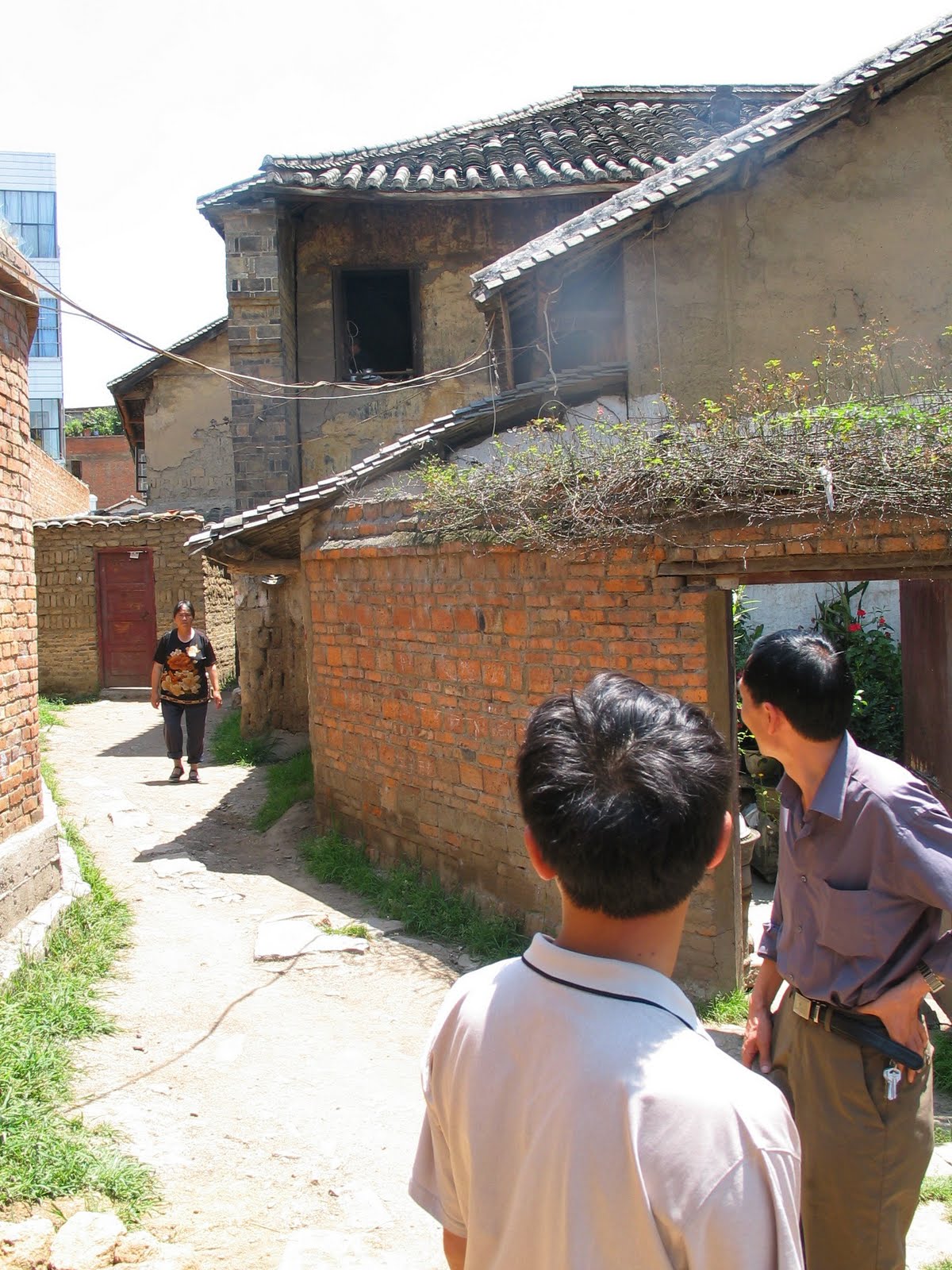
The one building I was not allowed to go into was the crumbling two story building where Pollard ministered (downstairs) and had his bedroom and office (upstairs). In Pollard’s day, construction was done with mud bricks, and it was so old the officials were worried about it falling down.

Later, we drove outside the city to the compound of Long Yun (龙云, 1884-1962), the warlord/governor who ruled Yunnan from 1927-1948. This had once been a very elegant estate, with dozens of beautiful buildings.

I even found some spiders to photograph.
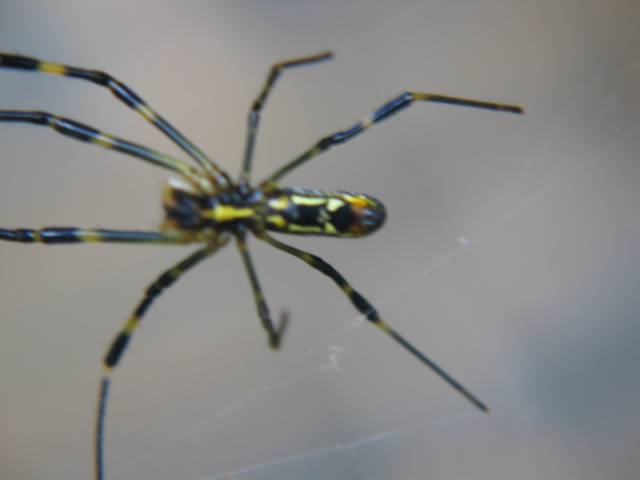
The Chinese have investigated the possibility that animal behavior changes just before an earthquake and can be used for predictive purposes. If this spider was trying to tell me something, I missed it.
We enjoyed visiting with the crowd of local people who took an interest in us.


Then we returned to town in our taxi.
Sometime during that trip, the earthquake hit. It killed four people, injured another 594, collapsed 6,185 houses and damaged 21,867, leaving 126,000 people homeless. Yet riding in the taxi, we never felt anything.
We only realized there had been an earthquake when we arrived back at our hotel. Dozens of people came running out of the tall building to escape one of the aftershocks. Later, we went to an internet café. While sending emails to say I was okay, I was aware of several aftershocks. I never actually saw any damage and only realized the severity of the quake after we had moved on. We had to be on the train at 4:00 the next morning, so I have no idea how Pollard’s original building or Long Yun’s fared in the quake. I may have been among the last people to see some of these historic relics standing.
So from this quake, the seismological lesson is that whether the spiders warn you of the coming quake, or not, take a taxi if you possibly can.